
Will AI Make Your Business Smarter, Faster, or aRiskier?
Artificial Intelligence (AI) has quickly become the buzzword of modern business strategy. But while organisations race to adopt AI for efficiency, productivity, and competitive advantage, many leaders are left wondering: Is this making us more vulnerable than we realise?
In today’s post-pandemic, cloud-first world, the answer isn’t always simple. AI offers enormous business upside, but it also opens new threat vectors that traditional cybersecurity strategies can’t keep up with. At FusionRed, we help business leaders make sense of the risks so they can adopt AI with confidence, not fear.
How AI Is Changing the Cyber Threat Landscape
How AI Is Changing the Cyber Threat Landscape
Cybercriminals are already using AI to scale attacks faster than ever. Phishing emails are now crafted with flawless grammar and company-specific detail using generative AI. Deepfake voice and video content are being used to impersonate executives and authorise fraudulent transactions. Meanwhile, AI-generated malware adapts in real time, slipping past legacy defences.
Traditional systems simply weren’t built to detect these types of threats. And for SMBs without in-house cybersecurity teams, this puts them squarely in the crosshairs.
“We’re now dealing with threats that look and feel legitimate. If your team isn’t prepared to spot them, you’re already a step behind.”
Elliot Seeto, Cybersecurity Evangelist, FusionTalk Webinar
Key Cybersecurity Questions Every Business Leader Should Ask
Protecting your organisation doesn’t start with tech. It starts with asking the right questions:
-
Are our teams trained to recognise AI-generated threats?
-
Do we have tools in place to detect AI-assisted attacks in real time?
-
Have we assessed where AI is creating new risk in our systems?
-
Do we have an incident response plan for AI-related breaches?
If you can’t confidently answer “yes” to these questions, it’s time for a strategic reset.
The AI-Attack Protection Checklist
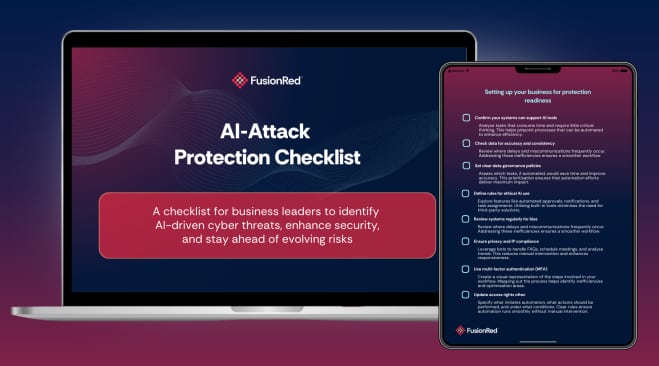
FusionRed has developed a comprehensive and actionable checklist to help SMBs get started.:
1. Evaluate IT infrastructure and data quality
Make sure your systems can support secure AI operations with accurate, high-quality data.
2. Implement responsible AI practices
Set guidelines around ethics, fairness, and compliance to reduce exposure.
3. Strengthen access controls
Apply multi-factor authentication and least-access policies to limit attack surfaces.
4. Enhance real-time threat detection
Use AI-driven tools that can spot unusual behaviour before damage is done.
5. Educate staff on AI-generated threats
Your people are your first line of defence, empower them to spot sophisticated attacks.
6. Continuously monitor and audit AI use
Regular reviews of your AI footprint help identify risks before attackers do.
Make it Easier with Our FREE Downloadable Guide
Inside the AI-Attack Protection Checklist, you’ll discover:
- Assess the cybersecurity readiness of your IT infrastructure
- Implement responsible and compliant AI practices
- Detect AI-driven threats in real time
- Train your team to respond to emerging cyber risks
- Take action to protect your business from evolving threats
FAQs
Attackers are using AI to scale spear-phishing campaigns, craft deepfake videos, and launch highly believable social engineering attacks.
AI allows attackers to bypass signature-based detection by constantly evolving tactics, making traditional systems outdated faster.
Leaders need to understand how AI is used both offensively and defensively, invest in AI-aware cybersecurity tools, and regularly review their risk exposure.
Many policies have exclusions around emerging technologies like AI; insurers are increasingly scrutinising the cybersecurity posture of businesses.
Download the AI-Attack Protection Checklist and use it to run an internal assessment of where their current defences stand.
Final Thoughts: Prepare, Don’t Panic
AI is not going away. It’s going to play an even larger role in how we run our businesses, and how they are attacked. The difference between resilience and risk lies in preparation.
Start with the checklist. Ask the hard questions. And if you’re not sure where your business stands, we’re here to help.