How to Stop Hackers from Attacking Your Website

Win Contracts. Keep Clients.
Published On: May 13, 2026 | Categories: Guides & Know Hows

Introduction

Your IT Says You’re Protected. Your Insurer Isn’t So Sure.

For many Australian SMB leaders, cybersecurity feels like a solved problem. You’ve got Microsoft 365. Maybe a firewall. Your IT provider checked in last year and said everything looks fine.


So when a prospective enterprise client asks for documented proof of your cybersecurity posture, or your insurer sends a 40-question underwriting form at renewal. The “we’ve got antivirus” answer suddenly doesn’t hold up.


These aren’t hypothetical situations. They’re the real-world commercial consequences of a framework gap, and they’re playing out across Australian SMBs right now.


This blog breaks down the two cybersecurity frameworks that matter most for Australian business leaders: the Essential Eight and SMB1001. In plain language. No jargon. Just clarity on what they are, how they differ, and why not having either in place is already costing businesses more than they realise.

The Gap Most Business Leaders Don’t See Coming

There’s a pattern playing out across Australian SMBs, and it tends to follow the same script.


A business does the basics. Antivirus, email filtering, maybe MFA on Microsoft 365. They pay their IT provider and trust that security is handled. No breaches. No drama. And for a while, that’s enough.


Then one of these happens:

  • Cyber insurance renewal arrives with premiums up 30% — or the insurer asks for documented security controls and the business can’t produce them.
  • A prospective enterprise client sends a supplier questionnaire about cybersecurity frameworks and incident response plans. Nothing is documented. The deal stalls.
  • A board member asks: “What frameworks are we aligned to?” The answer — “we’re not really sure” — creates an uncomfortable silence.

None of these involve a breach. But all of them have a real commercial cost.


According to the ACSC’s 2024–25 Annual Cyber Threat Report, Australian authorities received over 84,700 cybercrime reports in a single financial year, one every six minutes. The average cost per incident for small businesses hit $56,600, up 14% year-on-year. And 60% of small businesses that experience a significant cyber attack close within six months.

But the businesses feeling the sharpest pain right now aren’t always the ones getting attacked. They’re the ones quietly losing contracts and paying inflated premiums because they can’t demonstrate a measurable security posture when it counts.

What Are the Essential Eight and SMB1001?

The Essential Eight

Developed by the Australian Signals Directorate (ASD), the Essential Eight is a set of eight mitigation strategies designed to defend against the most common cyberattacks: application control, patching, MFA, restricting admin privileges, secure backups, and more.


It’s a solid technical baseline, and many IT providers reference it. But there’s a catch.


There’s no formal certification for the Essential Eight. No badge, no third-party-verifiable credential. Even if your systems are fully aligned to Maturity Level 2, you can’t hand that proof to a client or an insurer. It exists internally. It can’t easily travel.

SMB1001

SMB1001 is a cybersecurity certification standard built specifically for small and medium businesses by Dynamic Standards International (DSI). Currently in its SMB1001:2026 edition, it provides a tiered pathway (Bronze, Silver, Gold, Platinum, and Diamond) that businesses progress through.


Where the Essential Eight is about technical controls, SMB1001 adds governance, policy documentation, employee training, incident response planning, and business continuity — the elements that turn security tools into an organisational discipline.


Critically: SMB1001 is certifiable. A credential businesses can present to clients, insurers, and boards. Gold tier, for example, requires EDR, MFA across all applications, formal policies, a documented incident response plan, and cyber insurance coverage.

The Real Business Cost of Not Having a Framework

1. Cyber Insurance

Underwriters are tightening. Many now require documented evidence of security controls before offering coverage — or offering it at a reasonable premium. Without MFA across all systems, formal policies, tested backups, and an incident response plan, you’re looking at higher premiums, restricted coverage, or rejection at renewal.


SMB1001 certification gives you a documented framework to put in front of insurers directly. That’s not theoretical — it’s a tangible differentiator in the underwriting conversation.

2. Winning Contracts

Enterprise clients and government agencies are adding cybersecurity requirements to supplier qualification processes — particularly in financial services, healthcare, legal, and government-adjacent sectors.


If you have SMB1001 certification, you have a clear, recognised, third-party-verified answer when those questions come up. If you don’t, the decision often goes to a competitor who does. And you may never even know you lost.

3. Board and Leadership Governance

Directors are under growing pressure to demonstrate that cyber risk is being managed at an organisational level — not just delegated to the IT provider. SMB1001 provides the documentation and structure to present a clear posture to boards, investors, and external stakeholders with confidence. It turns “we’re working on it” into “we’re certified.”

How a Structured Framework Becomes a Competitive Advantage

Most business leaders frame cybersecurity as a cost, something you spend money on to avoid a bad outcome. That framing is costing businesses opportunities they don’t realise they’re missing.


For Australian SMBs operating in competitive markets, a structured framework is increasingly a commercial differentiator. Something that wins business, not just protects it. Consider what SMB1001 certification does in practice:


  • It answers the compliance question before it’s asked — your posture is already documented and certified.
  • It gives insurers confidence — signalling systematic risk management, which translates to better coverage and, often, lower premiums.
  • It gives leadership a language for boards — “We hold SMB1001 Gold certification” is a far stronger answer than “we think we’re covered.”
  • It builds client trust — in sectors where due diligence matters, formal certification is increasingly a factor in contract decisions.

The businesses that treat frameworks as a growth lever rather than a compliance burden are the ones building durable advantage as the market tightens.

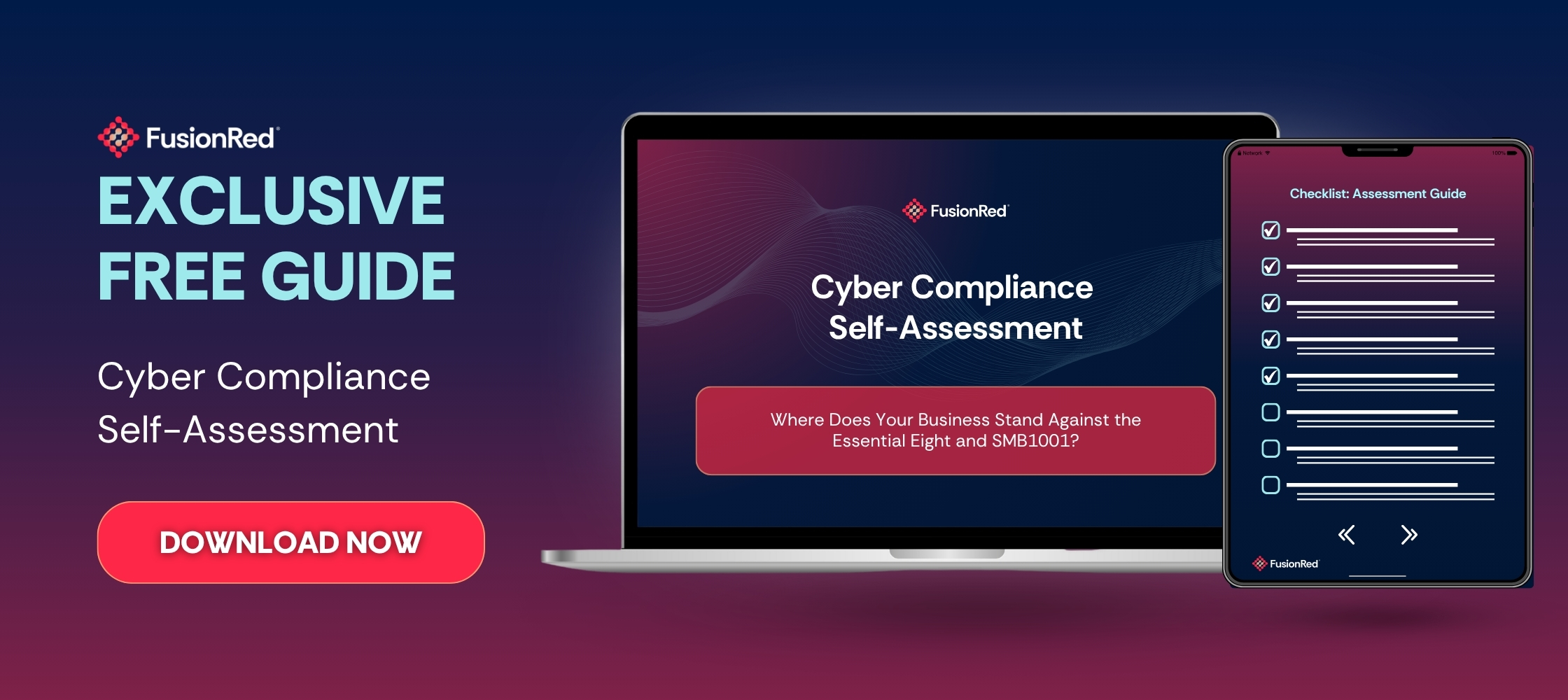
Make it Easier with Our FREE Downloadable Guide

Understanding the frameworks is one thing. Knowing where your business actually sits, and what it would take to close the gap, is another.


That’s why we created the Cyber Compliance Self-Assessment: a practical, business-friendly resource designed to help SMB leaders understand both frameworks, identify their gaps, and take the right first step toward a certifiable cybersecurity posture.


Take the first step toward a cybersecurity posture that works for your business and your clients.

FAQs

Question: What’s the difference between the Essential Eight and SMB1001?

Answer: The Essential Eight is a technical framework developed by the Australian Signals Directorate, it tells you what your security controls should look like. SMB1001 is a certifiable standard built for SMBs that wraps those technical controls in governance, training, and incident response. The key difference: SMB1001 can be formally certified and shown to clients, insurers, and boards. The Essential Eight cannot.


Question: Do I need to implement the Essential Eight before pursuing SMB1001?

Answer: Not necessarily. Many businesses pursue both in parallel. SMB1001’s Bronze and Silver tiers incorporate Essential Eight controls, so working toward certification naturally builds alignment with both frameworks. Your IT provider should be able to assess where you sit across both.


Question: We’ve never had a breach, does that mean we’re fine?

Answer: Not having a breach doesn’t mean your posture is solid — it may mean you haven’t been tested yet. More importantly, cyber insurance underwriters, enterprise clients, and boards don’t wait for a breach to ask about your security posture. The commercial pressure exists regardless of your breach history.


Question: What SMB1001 tier should our business be targeting?

Answer: For most businesses facing insurance, contract, or governance requirements, Gold tier is the practical target. Bronze is a strong starting point that’s achievable quickly. The right tier depends on your industry, client requirements, and current posture — which a Cyber Posture Snapshot can help clarify.


Question: How long does it take to achieve SMB1001 certification?

Answer: Timeline varies based on your current posture and target tier. Bronze is achievable relatively quickly for businesses with reasonable security basics in place. Gold typically requires a more structured program — usually several months — covering technical controls, policy documentation, staff training, and incident response planning.

Final Thoughts: The Framework Gap Is Closing Faster Than You Think

Cybersecurity frameworks used to be an enterprise concern. That’s no longer the case. The Essential Eight and SMB1001 are defining what “good” looks like for Australian businesses right now — and the commercial pressure to demonstrate a structured posture is only increasing.


The question isn’t whether to adopt a framework. It’s how quickly you can close the gap before it costs you something you didn’t expect to lose.

Take Action Today

If you’re unsure what’s your next step, book your free Cyber Posture Snapshot with FusionRed’s experts and walk away with a clear picture of where your business stands, and exactly what it takes to close the gap.

Related Articles

AI in Business: Smarter, Faster, or Riskier?

Will AI Make Your Business Smarter, Faster, or aRiskier? Artificial Intelligence (AI) has quickly become the buzzword of modern business strategy. But while organisations race to adopt AI for efficiency, productivity, and competitive advantage, many leaders are left wondering: Is this making us more vulnerable than we realise? In today’s post-pandemic, cloud-first world, the answer […]
Published On: September 24th, 2024 | Categories: April 29, 2025 | Categories: Guides & Know Hows

Setting Up Power BI for Your Business

Introduction Most business owners did not start their business to spend their time sorting out spreadsheets. But here they are every month, buried in Excel files, chasing missing numbers, and trying to make sense of reports that take forever to assemble.   If you feel like your business is drowning in spreadsheets, you are not […]
Published On: September 24th, 2024 | Categories: October 13, 2025 | Categories: Guides & Know Hows

How to Modernise Your Business

https://www.youtube.com/watch?v=jRl6Xisifuc “If my team already has Microsoft 365, why do our operations still feel stuck in the past?” That’s the question many business leaders ask themselves. They see their competitors moving faster, collaborating better, and handling change without panic—meanwhile, their own teams are stuck chasing approvals in endless email chains, or digging through old versions […]

Published On: September 24th, 2024 | Categories: August 5, 2025 | Categories: Guides & Know Hows