Introduction
Your IT Says You’re Protected. Your Insurer Isn’t So Sure.
For many Australian SMB leaders, cybersecurity feels like a solved problem. You’ve got Microsoft 365. Maybe a firewall. Your IT provider checked in last year and said everything looks fine.
So when a prospective enterprise client asks for documented proof of your cybersecurity posture, or your insurer sends a 40-question underwriting form at renewal. The “we’ve got antivirus” answer suddenly doesn’t hold up.
These aren’t hypothetical situations. They’re the real-world commercial consequences of a framework gap, and they’re playing out across Australian SMBs right now.
This blog breaks down the two cybersecurity frameworks that matter most for Australian business leaders: the Essential Eight and SMB1001. In plain language. No jargon. Just clarity on what they are, how they differ, and why not having either in place is already costing businesses more than they realise.
The Gap Most Business Leaders Don’t See Coming
There’s a pattern playing out across Australian SMBs, and it tends to follow the same script.
A business does the basics. Antivirus, email filtering, maybe MFA on Microsoft 365. They pay their IT provider and trust that security is handled. No breaches. No drama. And for a while, that’s enough.
Then one of these happens:
- Cyber insurance renewal arrives with premiums up 30% — or the insurer asks for documented security controls and the business can’t produce them.
- A prospective enterprise client sends a supplier questionnaire about cybersecurity frameworks and incident response plans. Nothing is documented. The deal stalls.
- A board member asks: “What frameworks are we aligned to?” The answer — “we’re not really sure” — creates an uncomfortable silence.
None of these involve a breach. But all of them have a real commercial cost.
According to the ACSC’s 2024–25 Annual Cyber Threat Report, Australian authorities received over 84,700 cybercrime reports in a single financial year, one every six minutes. The average cost per incident for small businesses hit $56,600, up 14% year-on-year. And 60% of small businesses that experience a significant cyber attack close within six months.
But the businesses feeling the sharpest pain right now aren’t always the ones getting attacked. They’re the ones quietly losing contracts and paying inflated premiums because they can’t demonstrate a measurable security posture when it counts.
What Are the Essential Eight and SMB1001?
The Essential Eight
Developed by the Australian Signals Directorate (ASD), the Essential Eight is a set of eight mitigation strategies designed to defend against the most common cyberattacks: application control, patching, MFA, restricting admin privileges, secure backups, and more.
It’s a solid technical baseline, and many IT providers reference it. But there’s a catch.
There’s no formal certification for the Essential Eight. No badge, no third-party-verifiable credential. Even if your systems are fully aligned to Maturity Level 2, you can’t hand that proof to a client or an insurer. It exists internally. It can’t easily travel.
SMB1001
SMB1001 is a cybersecurity certification standard built specifically for small and medium businesses by Dynamic Standards International (DSI). Currently in its SMB1001:2026 edition, it provides a tiered pathway (Bronze, Silver, Gold, Platinum, and Diamond) that businesses progress through.
Where the Essential Eight is about technical controls, SMB1001 adds governance, policy documentation, employee training, incident response planning, and business continuity — the elements that turn security tools into an organisational discipline.
Critically: SMB1001 is certifiable. A credential businesses can present to clients, insurers, and boards. Gold tier, for example, requires EDR, MFA across all applications, formal policies, a documented incident response plan, and cyber insurance coverage.
The Real Business Cost of Not Having a Framework
1. Cyber Insurance
Underwriters are tightening. Many now require documented evidence of security controls before offering coverage — or offering it at a reasonable premium. Without MFA across all systems, formal policies, tested backups, and an incident response plan, you’re looking at higher premiums, restricted coverage, or rejection at renewal.
SMB1001 certification gives you a documented framework to put in front of insurers directly. That’s not theoretical — it’s a tangible differentiator in the underwriting conversation.
2. Winning Contracts
Enterprise clients and government agencies are adding cybersecurity requirements to supplier qualification processes — particularly in financial services, healthcare, legal, and government-adjacent sectors.
If you have SMB1001 certification, you have a clear, recognised, third-party-verified answer when those questions come up. If you don’t, the decision often goes to a competitor who does. And you may never even know you lost.
3. Board and Leadership Governance
Directors are under growing pressure to demonstrate that cyber risk is being managed at an organisational level — not just delegated to the IT provider. SMB1001 provides the documentation and structure to present a clear posture to boards, investors, and external stakeholders with confidence. It turns “we’re working on it” into “we’re certified.”
How a Structured Framework Becomes a Competitive Advantage
Most business leaders frame cybersecurity as a cost, something you spend money on to avoid a bad outcome. That framing is costing businesses opportunities they don’t realise they’re missing.
For Australian SMBs operating in competitive markets, a structured framework is increasingly a commercial differentiator. Something that wins business, not just protects it. Consider what SMB1001 certification does in practice:
- It answers the compliance question before it’s asked — your posture is already documented and certified.
- It gives insurers confidence — signalling systematic risk management, which translates to better coverage and, often, lower premiums.
- It gives leadership a language for boards — “We hold SMB1001 Gold certification” is a far stronger answer than “we think we’re covered.”
- It builds client trust — in sectors where due diligence matters, formal certification is increasingly a factor in contract decisions.
The businesses that treat frameworks as a growth lever rather than a compliance burden are the ones building durable advantage as the market tightens.
Make it Easier with Our FREE Downloadable Guide
Understanding the frameworks is one thing. Knowing where your business actually sits, and what it would take to close the gap, is another.
That’s why we created the Cyber Compliance Self-Assessment: a practical, business-friendly resource designed to help SMB leaders understand both frameworks, identify their gaps, and take the right first step toward a certifiable cybersecurity posture.
Take the first step toward a cybersecurity posture that works for your business and your clients.
FAQs
Question: What’s the difference between the Essential Eight and SMB1001?
Answer: The Essential Eight is a technical framework developed by the Australian Signals Directorate, it tells you what your security controls should look like. SMB1001 is a certifiable standard built for SMBs that wraps those technical controls in governance, training, and incident response. The key difference: SMB1001 can be formally certified and shown to clients, insurers, and boards. The Essential Eight cannot.
Question: Do I need to implement the Essential Eight before pursuing SMB1001?
Answer: Not necessarily. Many businesses pursue both in parallel. SMB1001’s Bronze and Silver tiers incorporate Essential Eight controls, so working toward certification naturally builds alignment with both frameworks. Your IT provider should be able to assess where you sit across both.
Question: We’ve never had a breach, does that mean we’re fine?
Answer: Not having a breach doesn’t mean your posture is solid — it may mean you haven’t been tested yet. More importantly, cyber insurance underwriters, enterprise clients, and boards don’t wait for a breach to ask about your security posture. The commercial pressure exists regardless of your breach history.
Question: What SMB1001 tier should our business be targeting?
Answer: For most businesses facing insurance, contract, or governance requirements, Gold tier is the practical target. Bronze is a strong starting point that’s achievable quickly. The right tier depends on your industry, client requirements, and current posture — which a Cyber Posture Snapshot can help clarify.
Question: How long does it take to achieve SMB1001 certification?
Answer: Timeline varies based on your current posture and target tier. Bronze is achievable relatively quickly for businesses with reasonable security basics in place. Gold typically requires a more structured program — usually several months — covering technical controls, policy documentation, staff training, and incident response planning.
Final Thoughts: The Framework Gap Is Closing Faster Than You Think
Cybersecurity frameworks used to be an enterprise concern. That’s no longer the case. The Essential Eight and SMB1001 are defining what “good” looks like for Australian businesses right now — and the commercial pressure to demonstrate a structured posture is only increasing.
The question isn’t whether to adopt a framework. It’s how quickly you can close the gap before it costs you something you didn’t expect to lose.
Take Action Today
If you’re unsure what’s your next step, book your free Cyber Posture Snapshot with FusionRed’s experts and walk away with a clear picture of where your business stands, and exactly what it takes to close the gap.
Evaluate Your Website Security and Protect Your Business from Cyber Threats
Download Website Security Assessment Guide!
Your website is one of the most important digital assets your business owns, but it is also one of the most common entry points for cyber attacks, malware infections, and data breaches.
The good news is that most website security risks are preventable when the right cybersecurity foundation is in place.
Download the Website Security Assessment Guide and take the first step toward protecting your website, securing your digital infrastructure, and reducing cyber security risks.
“You didn’t build your business to worry about hackers—but somehow, you’re the one staying up at night wondering if your systems are safe.”
This is the reality for many small to mid-sized business owners like Anthony from Parramatta. He’s great at running his business, but when news breaks about another local SME falling victim to a ransomware attack, his confidence wavers. He thinks: “If those companies got breached, what makes us any safer?”
Anthony doesn’t have a full cybersecurity team. He has a basic antivirus, a backup plan (sort of), and a lot of crossed fingers. Meanwhile, the threats keep evolving—phishing scams, supply chain breaches, insider risks. But what if the same tools and strategies used by top-performing corporations were not just available to SMBs—but made easy to deploy?
Introduction
You’re a business owner, not a cybersecurity expert. But somehow, you’re the one constantly wondering:
Are we safe from ransomware?
Would we even know if our systems were breached?
Why do some SMBs never seem to get hit?
The truth is, many small businesses rely on default protections, basic antivirus software, or outsourced IT support that only reacts after something breaks. Meanwhile, top-performing businesses—both large and small—use strategic, layered security frameworks to stay protected.
This isn’t just about fancy tech. It’s about peace of mind. In our latest FusionTalk (as seen on the video above), we unpacked the strategies used by successful corporations and elite SMBs to defend against cyber threats.
The Silent Risk – Why Basic Security Isn’t Enough
Most SMBs operate under a dangerous assumption: “If we haven’t been breached yet, we must be doing something right.”
But here’s the problem:
Default antivirus is not enough.
Your outsourced IT team might not be monitoring threats 24/7.
Backups may not be tested or even recoverable.
Employee awareness training is often skipped or ineffective.
The result:
Downtime when ransomware strikes.
Lost data after a simple phishing attack.
Legal and financial exposure after a breach.
The silent killer is false confidence. You think you’re safe, until you’re not. And by the time you realise it, your systems are locked, your data is gone, and your customers are questioning your credibility.
What Top Companies Do Differently (That You Can Too)
Top-performing companies don’t wait for an attack to happen. They build a resilient defence using layers of security. Here’s what their strategy typically includes:
1. Identity and Access Management
Use multi-factor authentication (MFA) across all business accounts.
Ensure employees don’t reuse weak passwords or share credentials.
Implement role-based access—only give staff the access they truly need.
2. Endpoint Detection and Response (EDR)
Monitor all devices (laptops, mobile, desktops) for real-time threats.
Detect and isolate suspicious activity before it spreads.
3. Automated Patch Management
Keep all systems up to date with critical security patches.
Prevent zero-day vulnerabilities from being exploited.
4. Email Threat Protection
Advanced filtering to block phishing, spoofing, and malware-laced emails.
Educate staff with simulated phishing campaigns to boost awareness.
5. Data Backup and Recovery
Encrypted, cloud-based backups tested regularly.
Fast recovery in case of disaster or ransomware.
6. Security Monitoring and Response
24/7 system monitoring with automated threat alerts.
Incident response playbooks tailored for the business.
Make it Easier with Our FREE Downloadable Guide
Ready to put these strategies into action for your own business?
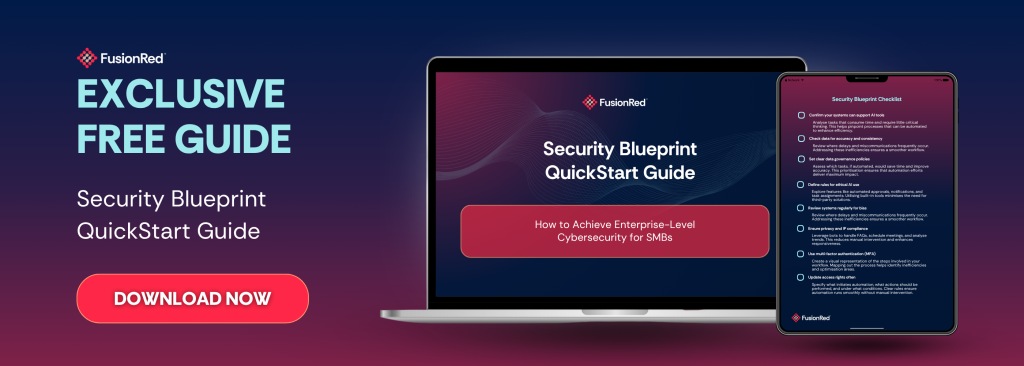
Our free downloadable Security Blueprint QuickStart Guide makes it easy for SMBs to get started with a proven framework. It is designed to help business owners and IT leads build foundational protections with clarity and speed—no technical expertise required.
Download the guide to discover:
The core steps to building a layered security posture
The must-have configurations top-performing businesses rely on
A checklist of critical controls for ransomware resilience, data protection, and threat monitoring
Practical recommendations to reduce downtime and increase compliance
The guide has helped many businesses start securing their digital environment with confidence. Now it’s your turn.
Download your free copy and start implementing your enterprise-grade cybersecurity foundation today.
FAQs
Question: What is the Security Blueprint QuickStart Guide and how can it help me?
Answer: It’s a free downloadable checklist that walks SMBs through key steps to strengthen their cybersecurity posture—using Microsoft-native tools you may already have. It’s designed for clarity, action, and real-world application.
Question: Do I need a dedicated IT team to implement this free guide?
Answer: No. The guide was built for SMBs without internal IT staff. It provides practical steps that any business owner or generalist can follow.
Question: Is this guide suitable for non-technical business owners?
Answer: Yes. The checklist uses clear, jargon-free language and simple action items that are easy to understand and implement.
Question: What tools are required to follow the guide?
Answer: The guide references Microsoft tools, but other alternatives that are publicly available can still do the job!
Question: How can I tell if our business needs this high-level of cybersecurity?
Answer: If you’re handling sensitive data, relying on remote work, or simply want to avoid disruption from ransomware or phishing, then yes—these steps are essential.
Conclusion
Cybersecurity should not be a mystery or a luxury. The tools are there, the strategies are known, so what’s missing? It’s execution. Take your first step towards securing your business’ future today using our free guide, and make your business’ cybersecurity indestructible!
Want to Take Action Without the Overwhelm?
If you are ready to protect your business like the top performers do (without the overwhelm), book a free consultation with FusionRed. Let’s build your indestructible cybersecurity blueprint together!